


What started as an experiment with agentic coding has grown into an international initiative bringing auditors, AI builders and ethical hackers together.
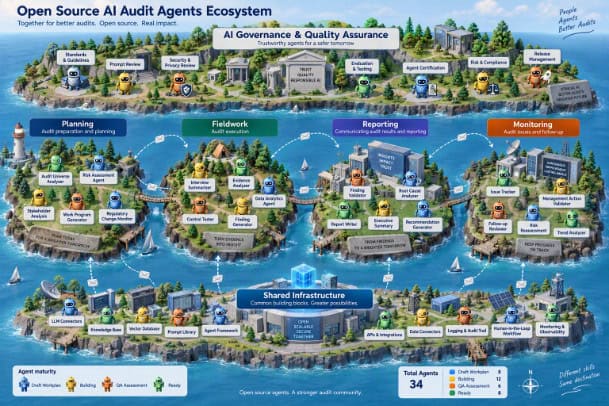
The Shared Audit Agents Framework (SAAF) has rapidly evolved from a small-scale experiment into a growing open-source initiative with international ambitions.
In this article, Eduward van de Kamp shares the story behind SAAF, its unexpected challenges, the growing collaboration across the audit and AI communities, and its ambitious plans for the future.
How It All Started
What started as a shared passion for AI-powered coding has developed into an initiative with the potential to transform the auditing profession.
When Eduward van de Kamp and Mathijs Schouten first experienced the capabilities of Claude and agentic coding in late 2025, they saw an opportunity to introduce more auditors to this technology.
This led to the creation of the Shared Audit Agents Framework (SAAF), an open-source, vendor-agnostic initiative developed for and by auditors.
The Unexpected Reality of AI Governance
The SAAF journey began in January 2026 at Mollie, where participants could explore various large language models, including Claude, Gemini, OpenAI models and Mollie’s own GPT environment.
The first session focused on identifying potential use cases. During the second session, 60 enthusiastic participants installed Claude Code and GitHub to begin experimenting.
However, as interest grew, unexpected challenges emerged.
Registrations increased so rapidly during the third and fourth sessions that they temporarily had to be paused. Installing the required software could take almost half a day, largely due to internal governance and security processes that delayed access to LLMs within organizations.
A pragmatic workaround was to use private laptops.
Despite these challenges, enthusiasm for SAAF and agentic AI continued to grow throughout the auditing community.
From Local Experiments to a Nationwide Initiative
Since its launch, SAAF has organized ten hackathons and two alignment sessions, taking the initiative on a tour across the Netherlands.
Following the first sessions at Mollie, organizations including Schuberg Philis, Wolters Kluwer, NOREA, IIA, KPN, ASML and Just Eat Takeaway.com have welcomed the initiative.
These organizations have supported the sessions by providing venues and facilities, helping create an environment for knowledge sharing and collaboration.
Another important milestone has been the authorization to award CPE points for eligible sessions on behalf of ISACA, IIA and NOREA.
SAAF is also collaborating with the NBA and ForHumanity, further strengthening connections across professional communities.
International Recognition and Collaboration
A key element of SAAF’s success is its focus on co-creation.
What began primarily as an initiative for auditors has expanded to include ethical hackers and AI builders.
Following a session at Just Eat Takeaway.com, SAAF also began collaborating with TAG (To Achieve Greatness), an Amsterdam-based AI-building community.
Bringing these different disciplines together has accelerated innovation and contributed to a growing GitHub repository of open-source tools and resources.
The initiative is now also gaining international recognition.
SAAF has been selected as a top-three finalist in the Training and Education Programme category at the EU Risk Management Awards, taking place in London on 9 November 2026.
Following the awards, SAAF will return to Mollie on 10 November for a dedicated red-teaming session, where experienced Dutch hackers will test the agents and identify opportunities to strengthen their security.
Further sessions are planned at BDO in Amsterdam, followed by a year-end gathering at NOREA. This final event will bring together representatives from the academic audit community, audit departments and AI knowledge groups within NOREA, IIA, ISACA and the NBA to discuss SAAF’s future direction.
What’s Next for SAAF?
The next phase of SAAF will focus on making AI-powered auditing more accessible while continuing to develop secure, practical applications.
Together with its partners, the initiative plans to introduce targeted courses for different experience levels, from beginners to advanced practitioners.
These activities will help auditors apply AI throughout the audit process, supported by practical hackathons focused on agent development, security testing and bug bounties.
A European AI Hackathon in 2027
One of SAAF’s most ambitious plans is a month-long European AI hackathon, live-streamed from Amsterdam’s Zuidas business district.
The event will bring together multidisciplinary teams consisting of:
- An auditor
- An AI builder
- An ethical hacker
Participants will be able to register individually or join with their organization’s audit department.
Audit teams from across Europe will compete for the title of ‘Most Innovative Audit Department in Europe’.
Individual participants will have the opportunity to be matched with AI builders and ethical hackers, making the initiative accessible to professionals whose organizations may not yet have dedicated AI development teams.
The closing ceremony is planned to feature cash prizes to support the further development of promising solutions into enterprise-grade, production-ready applications.
With support from ISACA chapter organizations, SAAF aims to expand the initiative across more than 30 European countries.
The long-term objective is to enable participating organizations to deploy AI agents securely within their own corporate environments.
Supporting the Future of AI-Powered Auditing
Throughout 2026, the SAAF initiative has been developed and organized entirely through voluntary contributions.
To maintain its momentum and support further professionalization, SAAF is now seeking funding and sponsors.
Organizations interested in contributing can help support the continued development of its open-source framework, educational activities and international collaboration.
As Eduward van de Kamp emphasizes, the initiative is about more than developing new tools. It is about bringing professionals together to build a future-proof audit ecosystem.
Interested in contributing to the future of AI in auditing or supporting the SAAF initiative?
Visit the website: https://saafproject.com/
Article by Eduward van de Kamp & Mathijs Schouten
